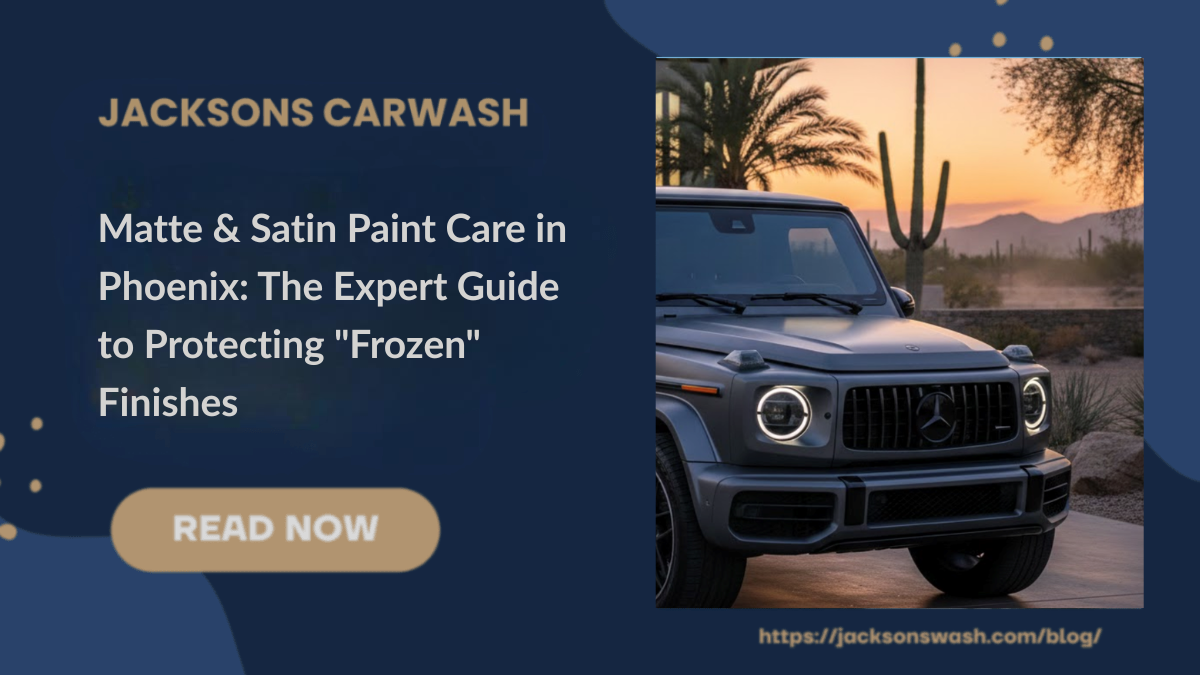
Key Takeaways
- Modern matte is mainstream. Factory “Frozen,” “Magno,” and satin paints from brands like Mercedes-Benz, BMW, Genesis, and Hyundai are now common in the Valley—but they require very different care than traditional glossy clear coat.
- Matte paint cannot be buffed. The textured surface creates the satin look. Using the wrong wax, polish, or even a dirty wash mitt can permanently create shiny spots that cannot be corrected with normal paint correction.
- Phoenix conditions are high risk. Hard water, extreme UV, and desert dust in Phoenix and Scottsdale can etch into the texture of matte paint, making professional, matte-safe washing and protection a necessity rather than a luxury.
- Professional chemistry and technique matter. Jacksons technicians rely on pH-neutral soaps formulated for sensitive finishes and air-only or ultra-soft-drying methods to avoid burnishing and preserve the factory look.
Why Matte and Satin Paints Are Suddenly Everywhere in the Valley
For years, matte and satin finishes were reserved for custom wraps and ultra-limited performance models. That has changed. Today, major manufacturers offer factory matte options straight from the showroom floor. Mercedes-Benz calls it “designo Magno,” BMW uses names like “Frozen Black” or “Frozen Gray,” and brands such as Genesis and Hyundai have introduced satin-style finishes on SUVs and performance sedans.
The result is visible every weekend around Phoenix and Scottsdale: matte-finished G-Wagens at upscale shopping centers, Frozen BMW M cars at coffee meets, satin-finished Genesis SUVs cruising the 101. These vehicles stand out because the paint absorbs light instead of reflecting it, giving a soft, modern, almost concept-car presence.
However, the same texture that creates that distinctive low-gloss look also makes the finish far less forgiving. Owners quickly discover that standard car-care habits—automatic wax, harsh brushes, or “whatever soap is in the garage”—can leave permanent visual scars on a matte or satin car.
The High Stakes of Caring for Matte Paint
Traditional glossy paint is designed to be polished. When fine scratches appear, a professional can use a machine polisher and carefully remove a tiny amount of clear coat to restore gloss. Matte and satin finishes are different by design. The clear coat contains microscopic texture that diffuses light, and any smoothing of that texture creates shine.
That is why one wrong move—an abrasive pad on a stubborn spot, a standard wax formulated to increase gloss, or a gritty brush—can permanently change the appearance of a panel. Instead of an even satin sheen, the vehicle ends up with random glossy patches where the texture has been flattened. Unlike traditional clear coat, those shiny spots cannot simply be “polished back out” without destroying the matte effect altogether.
Manufacturers treat this as a technical requirement, not a cosmetic suggestion. In their official matte paint care guide, Genesis explicitly warns that traditional waxes, polishes, and even vigorous rubbing can create permanent shiny spots on matte finishes. Similar cautions appear across the premium segment, underscoring that matte paint must be treated as a specialty surface.
The Phoenix Factor: Why Matte Finishes Are at Extra Risk Here
In a mild coastal climate, matte paint already demands special care. In Phoenix and Scottsdale, the challenge is multiplied. Three local realities make factory matte and satin finishes particularly vulnerable:
1. Hard Water and Spotting
Arizona is known for hard water with high mineral content. When water dries on the paint, it leaves behind mineral deposits that can etch into clear coat over time. On a glossy car, light polishing can often reduce or remove mild spotting. On a matte vehicle, the textured clear coat traps those minerals in the microstructure, and polishing is not an option without changing the sheen.
2. Desert Dust as Sandpaper
Dust in the Valley is not just a light cosmetic film. It can include fine sand and mineral particles. On a matte finish, dragging that dust around with a dry towel or an old wash mitt can crush the texture in countless micro-areas, creating subtle glossiness and inconsistent shading. The damage may not be obvious immediately, but under certain angles and lighting it becomes very visible.
3. Intense UV and Heat
Matte clear coats, like glossy ones, are still polymers that degrade under ultraviolet light. When combined with extreme temperatures, sunscreen residue, bug remains, and bird droppings, the risk of staining is higher. Because the surface cannot be aggressively machine-polished, mistakes and neglect are far more expensive to reverse—often requiring repainting or partial panels rather than simple correction.
Why “Normal” Car Care Rules Do Not Apply to Matte Paint
Owners accustomed to standard finishes often assume a few things that simply are not safe for matte or satin vehicles:
- “Any wax is good wax.” Many consumer waxes and sealants are designed to increase gloss. On matte paint, those products can fill the microscopic texture, leading to uneven shine and patchy areas that are almost impossible to fix.
- “A stronger brush means a cleaner car.” Traditional stiff brushes or old wash mitts with embedded grit can flatten matte texture instantly. Even a single aggressive spot-scrub can leave a visible shiny mark.
- “A drive-through wash is fine if it’s convenient.” Many automated washes are not calibrated for matte-friendly chemistry or ultra-gentle contact. Friction-based systems combined with gloss-enhancing chemicals can gradually erode the factory look.
For vehicles with Frozen, Magno, or satin paint, the margin for error is extremely small. The goal is no longer to “correct” defects afterwards, but to avoid creating them in the first place.
What Makes Matte Paint Different: Texture, Not Just Color
Underneath, most modern matte finishes still sit on a standard color coat and primer. The key difference is in the clear coat. Instead of being engineered for high gloss, the clear coat contains special agents and a calibrated surface profile that scatter light rather than reflecting it uniformly.
That micro-texture is what gives a matte-black Mercedes-AMG or a Frozen-gray BMW its soft, rich appearance. It also means any smoothing, filling, or gloss-boosting effect—from polishes, waxes, or friction—will alter the way light reflects and break the uniform look that makes the car special.
In practice, this calls for a complete re-think of how the vehicle is washed, dried, and protected. Everything from the soap formula to the drying method must be chosen to clean without polishing.
The Professional Solution: Matte-Safe Detailing at Jacksons
Because of these risks, many Phoenix and Scottsdale owners of matte-finished vehicles look for specialists rather than experimenting in the driveway. Jacksons Car Wash has developed specific protocols in its auto detailing program to handle matte, Frozen, Magno, and satin factory paints safely.
pH-Neutral, Matte-Compatible Soaps
For sensitive finishes, Jacksons technicians rely on pH-neutral shampoos that are free from gloss-enhancing additives. These formulas focus on safely lifting contaminants from the surface rather than trying to add shine. This is essential for preserving the original low-sheen look.
Soft Media and Strict Wash-Mitt Control
Wash mitts and applicators used on matte finishes are carefully controlled. Dedicated microfiber mitts are reserved exclusively for these vehicles, minimizing the risk of embedded grit. Aggressive brushes are avoided on paint surfaces, and any bug removal or tar lifting is performed with gentle, matte-safe techniques.
Air-Only and Ultra-Gentle Drying
Drying is one of the most critical stages. Even a high-quality towel can burnish a matte surface if used with pressure or in circular motions. For this reason, Jacksons follows an air-first philosophy for matte vehicles—using controlled air-drying as much as possible, and only supplementing with ultra-soft microfiber when absolutely necessary and with minimal contact. The goal is to avoid “buffing” the paint while still preventing water spotting.
Matte-Friendly Protection Strategies
Protection for matte finishes is not about gloss; it is about barrier performance. Technicians may recommend matte-safe sealants or coatings that preserve the diffused look while adding resistance against UV, water spotting, and environmental fallout. These products are chosen specifically because they do not fill or flatten the texture.
Manufacturer Warnings: Why the Rules Are So Strict
Owning a matte vehicle comes with a unique set of “Don’ts” that can catch Phoenix drivers off guard. It is not just a marketing suggestion—it is a mechanical requirement. In their official matte paint care guide, Genesis explicitly warns that standard car wash chemicals, conventional waxes, and even basic friction can create permanent shiny spots and irreversible marks on matte finishes. This is why professional detailing teams treat these paints with a completely different chemistry and a strict no-burnish, low-contact drying protocol.
Similar guidance appears across the luxury segment because the underlying physics are the same: once the textured clear coat is flattened in a spot, it will reflect light like a gloss surface, and that contrast is extremely difficult to hide.
Why Phoenix and Scottsdale Matte Owners Should Think “Prevention First”
For glossy vehicles, the mindset is often “If it scratches, it can be polished.” With matte finishes, the mindset must shift to “If it scratches, it may be permanent.” That is especially true in Phoenix and Scottsdale, where daily driving includes:
- High-speed freeway runs that collect bugs and road film on the front end.
- Occasional monsoon storms that leave behind mineral-rich water spots.
- Parking in open lots where sprinkler overspray and dust storms are regular events.
Each of these factors adds contaminants to a surface that cannot be aggressively corrected later. That is why experts recommend a professional, matte-safe hand wash or detail on a consistent schedule—before small issues have a chance to set in.
Practical Ownership Tips for Matte, Frozen, and Satin Finishes
1. Treat Every Wash as a High-Stakes Interaction
Matte paint is unforgiving of shortcuts. It is recommended to avoid random drive-through washes, strong household cleaners, or unknown towels. If a vehicle must be rinsed at home, gentle pre-rinse and minimal contact with a clean, dedicated mitt are vital—and any stubborn spots should be left for professionals rather than scrubbed.
2. Respond Quickly to Contaminants
Bug remains, bird droppings, and sprinkler spots are particularly risky on matte finishes. The longer they sit, the higher the chance of permanent staining. Quick, gentle removal with matte-safe methods—or a prompt visit to a professional detail center—can make the difference between a reversible issue and a permanent mark.
3. Plan for Professional Support from Day One
Instead of waiting until dullness or spotting appears, the most successful matte owners in Phoenix treat professional care as part of the ownership experience. That often means establishing a regular schedule with a trusted facility that understands matte paint and has the chemistry, tools, and training to support it long term.
Why Jacksons Is Positioned as a Matte-Finish Partner in the Valley
Jacksons Car Wash operates multiple locations across the Valley and sees an increasing volume of factory matte and satin finishes every year. The detailing teams are trained to identify these finishes on arrival and adjust wash and drying protocols accordingly, with an emphasis on:
- Safe, pH-neutral shampoos and controlled foam application.
- Dedicated soft media for matte vehicles only.
- Air-first drying to minimize any risk of burnishing.
- Matte-appropriate protection recommendations—not gloss-boosters.
This approach is designed around asset preservation. For many Phoenix and Scottsdale drivers, a matte-finished vehicle is a significant investment. Keeping that unique look intact is not only about pride of ownership; it is also about protecting resale value in a market where paint condition is a major factor.
Conclusion: If the Finish Is Special, the Care Has to Be Special
Frozen, Magno, satin, and other matte-style paints offer some of the most striking looks on the road today. They also demand a level of care that typical car-care routines simply do not provide—especially in a high-UV, hard-water, dust-prone environment like Phoenix and Scottsdale.
Between the inability to safely buff defects, the risk of permanent shiny spots, and the local realities of desert driving, professional, matte-aware care is no longer optional for these vehicles. It is the baseline for preserving the exact look that made the vehicle appealing in the first place.
Drivers who want to keep their matte or satin car looking new are encouraged to schedule a matte-safe wash or detail with Jacksons and discuss a care plan tailored to their specific vehicle and driving habits. To locate the most convenient site in the Phoenix metro area, visit Jacksons’ locations page and select the facility best suited to the vehicle’s needs.
No. Traditional machine polishing is not safe for matte or satin paint. Polishing flattens the textured clear coat, creating shiny spots that cannot be blended back to a uniform matte finish.
Hard water can leave mineral deposits that settle into the texture of the matte clear coat. On glossy paint, some spotting can often be polished away; on matte paint, etched spots may be permanent or very difficult to reduce.
In a desert climate with dust, bugs, and hard water, many owners benefit from a professional matte-safe wash every 1–2 weeks, especially if the vehicle is driven daily or parked outside.
For many owners, yes. Matte-specific films and coatings help shield the textured clear coat from stains, fallout, and UV exposure while keeping the low-gloss look. They do not replace proper washing but make ongoing care safer and easier.
If towels are needed, very soft, clean microfiber should be used with light pressure and straight-line motions to reduce the risk of burnishing the surface.