Key Takeaways (TL;DR)
- The Fingernail Test: Gently glide a clean fingernail across the scratch. If it catches, the damage is deeper than a simple surface mark. If it glides smoothly, you’re usually looking at clear-coat level defects we can often correct with polishing.
- The Water Trick: Lightly mist the scratch with water. If it seems to disappear when wet and reappear when dry, the damage is likely in the clear coat only—ideal for professional paint correction.
- Preserving Clear Coat Comes First: A “perfect” repair that removes too much clear coat is not a win. Our priority at Jacksons is to protect the long-term health of your paint system, even if that means reducing the visibility of a scratch instead of chasing 100% removal at any cost.
Why Scratches Make Phoenix Drivers Nervous
Every day across the Valley, we see the same expression on customers’ faces when they step out of their vehicles and point to a scratch: a mix of frustration, worry, and a little bit of guilt. Phoenix is tough on paint. Between tight parking at crowded shopping centers, highway debris on the 101 or I-10, and the simple reality of dust and desert landscaping, it’s not a matter of if your car will get scratched—it’s when, and how badly.
At Jacksons, we operate multiple locations across the Phoenix metro area, including busy sites like our Phoenix Highland auto detailing location. As the lead detailer, my team and I see thousands of vehicles move through our tunnels and Detail Centers each week. We see everything from light “spiderweb” swirls on brand-new cars to deep key marks that cut right through the paint layers. Over time, we’ve learned that the first and most important step is not grabbing a machine polisher—it’s making the correct diagnosis.
This article is our way of sharing that diagnostic process with you. Think of it as a professional playbook you can use at home before you spend a dollar on DIY kits or commit to any repair work. If you can “read” your paint the way we do in the bay, you’ll make better decisions, protect more of your clear coat, and avoid chasing the wrong solution.
The Fingernail Test: Your First Line Diagnosis
The simplest and most effective tool you have for assessing a scratch is literally at the end of your hand. We use the fingernail test every day in our Detail Center because it gives us instant, meaningful information without any special equipment.
How to perform the Fingernail Test:
- Start with a clean panel. Wipe away dust or dirt so you’re not dragging contamination across the paint.
- Make sure your fingernail is clean and dry—no lotion, no grease.
- Gently glide your nail perpendicular across the scratch, using very light pressure.
Interpreting what you feel:
- If your fingernail catches in the scratch: The damage has likely penetrated deeper than surface-level clear coat. This usually means the clear coat is fully broken and you may be into color (base coat), primer, or in severe cases even down to bare metal.
- If your fingernail glides smoothly: You’re probably looking at a surface defect—clear-coat level swirls, light scratches from washing, or very shallow marks. These are prime candidates for professional polishing and paint correction.
This test doesn’t replace a professional inspection, but it will keep you from expecting miracles where none are safe to perform. When a scratch fails the fingernail test, our goal at Jacksons shifts from “erase it completely” to “minimize the visual impact while keeping your protective layers intact.”
Anatomy of Automotive Paint: What’s Really at Risk?
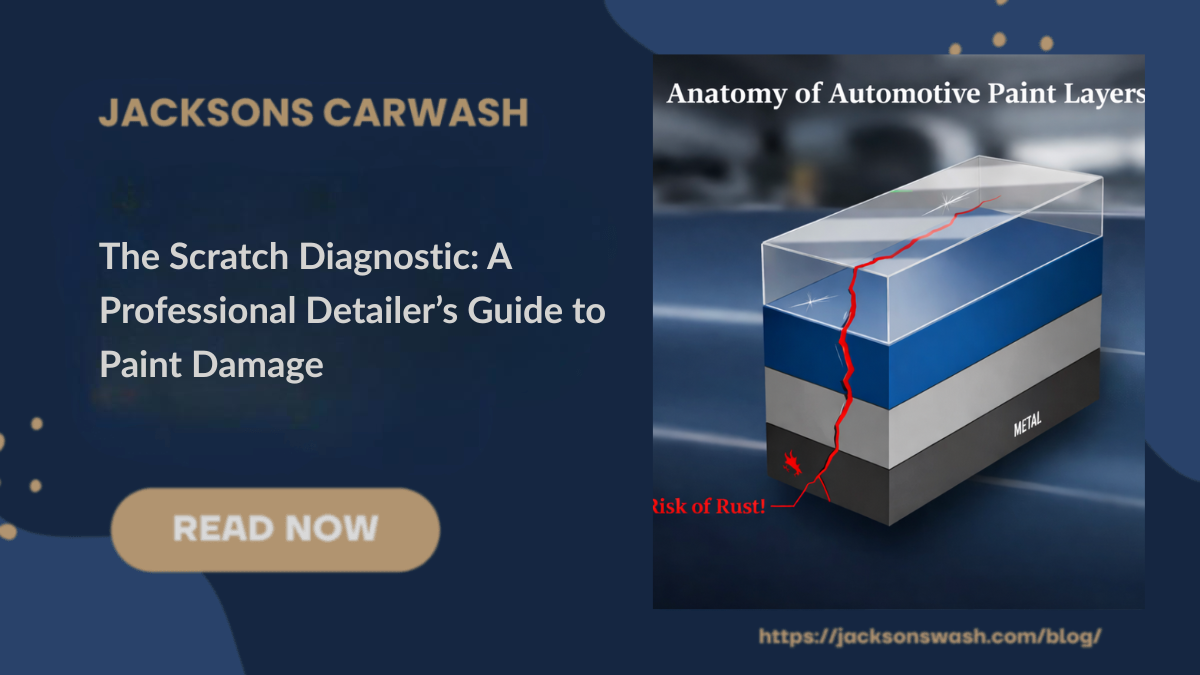
To understand why some scratches are relatively easy to correct while others demand caution, you need to know what you’re actually dealing with. Modern automotive paint is a layered system designed to balance appearance with protection.
From the outside in, most factory finishes include:
- Clear Coat: The transparent protective layer that gives your car its gloss and depth. It shields the color beneath from UV, chemical damage, and minor impacts.
- Base Coat (Color): The pigmented layer that gives your car its actual color—black, red, white, metallic blue, and so on.
- Primer: A bonding and corrosion-resistant layer that helps the base coat adhere to the underlying metal and adds an additional barrier against rust.
- Metal / Substrate: The steel, aluminum, or composite panel itself.
Visually, you can think of it as a cross-section like this:
As a professional detailer, my primary concern is the clear coat. You have only so much of it from the factory—often measured in microns, not millimeters. Every time we polish, we are removing a very thin amount to level the surface. Done correctly, it’s safe and incredibly effective. Done aggressively or repeatedly without measurement, it can permanently weaken your paint system.
The Professional Standard: Why We Don’t “Buff Until It’s Gone”
At Jacksons, we’re not chasing instant perfection for social media photos. We’re playing the long game with your paint. That means we focus on correction where it’s safe and smart, and we deliberately stop where factory protection would be compromised. Our work is guided by years of hands-on experience and a commitment to adhering to the professional standards of the International Detailing Association.
In practice, that looks like this:
- Using appropriate compounds and pads for the severity of the defect, rather than grabbing the most aggressive option first.
- Favoring multiple light passes over one heavy, risky correction step.
- Monitoring the results under proper lighting to avoid over-polishing a small area.
- Choosing to improve some defects rather than completely remove them when the remaining clear coat is a concern.
This is where being more of a consultant than a “buffing service” matters. Our responsibility is to your car’s long-term health, not just today’s before-and-after photo.
The Water Trick: Seeing Beyond the Scratch
The “water trick” is another simple diagnostic tool we use in the bay when a scratch is borderline and we want to confirm how deep it really is. You can do the same thing at home with a spray bottle or even a clean, damp cloth.
How to perform the Water Trick:
- Start with a clean panel so you’re not confusing dust with scratches.
- Lightly mist the scratched area with clean water, or gently wipe a wet microfiber across it.
- Observe the scratch while it’s wet, then again as the water evaporates.
What the results tell you:
- Scratch disappears (or nearly disappears) when wet: This usually means the damage is confined to the clear coat. Water fills the tiny valley and changes how light reflects, revealing that the color layer underneath is intact. These scratches are ideal candidates for professional polishing and paint correction.
- Scratch remains clearly visible even when wet: The damage may have reached the base coat or deeper. Because the color or primer is disturbed, water can’t “hide” it. In these cases, we treat the area much more cautiously and often shift from correction to camouflage and protection.
The fingernail test and water trick together give us a quick, reliable picture of what we’re facing—long before we reach for a machine.
When to Buff and When to Stop: The Jacksons Way
One of the hardest conversations we have with customers is explaining why a scratch shouldn’t be pushed to 100% visual removal. From the outside, it can feel like “if the scratch is still faintly visible, the job isn’t done.” From the professional side, we know that the final few percent of “perfection” often come at the cost of valuable clear coat thickness.
Our approach at Jacksons is straightforward:
- Light, clear-coat only defects: We’ll usually correct these fully with safe polishing, then refine and protect the area. This is where our auto detailing services shine—especially for swirls, light scratches, and wash-induced marring.
- Medium defects that pass the water trick but barely catch a nail: We’ll perform measured correction, improving the defect dramatically while preserving a healthy margin of clear coat. The goal is for it to be invisible in normal lighting, even if under harsh inspection lighting a trained eye can still see a slight trace.
- Deep scratches that fail the fingernail test and stay visible when wet: This is where we often choose to “round off” the edges of the scratch instead of chasing full removal. By softening the hard edges and leveling the surrounding clear coat, we can reduce how harshly the scratch catches the eye while keeping enough clear coat to protect the color and primer beneath.
We call this balance the Jacksons Way. It’s about being honest with what’s possible, explaining the trade-offs, and prioritizing the health of your paint system over a risky, short-term win. In some cases, that conversation includes recommending body-shop paintwork instead of further polishing, especially when the base coat, primer, or metal is exposed.
Conclusion: Knowledge Is Your Best Scratch-Repair Tool
As detailers, we work with paint every day—but you live with your vehicle every day. When you understand how to read a scratch using simple tools like the fingernail test, the water trick, and a basic knowledge of paint layers, you’re far less likely to waste money on the wrong products or unintentionally thin your clear coat with harsh DIY methods.
The next time you notice a scratch, take a breath and diagnose it before you panic. Ask yourself:
- Does my fingernail catch or slide?
- Does the scratch disappear when wet?
- Is there any sign of color change, primer, or bare metal?
If you’re still unsure, you don’t have to figure it out alone. Stop by any Jacksons Car Wash location for your normal wash, and if a scratch is bothering you, ask to speak with a supervisor or a member of our detailing team for a quick “scratch assessment.” We’ll walk you through what we see, what’s safely correctable, and what our professionals recommend as the next step—no pressure, no guesswork.
To find the Jacksons that best fits your routine, visit our locations page and choose the site most convenient to you in the Phoenix area. From a simple wash to advanced paint correction, we’re here to help you protect your vehicle’s finish for the long term, one careful decision at a time.
Frequently Asked Questions About Scratch Diagnostics
1. What if my scratch fails the “Fingernail Test”?
If your nail catches, the scratch has penetrated the clear coat. While it can’t be “buffed out” with standard polishing, our Detail Center can often use professional compounding or touch-up techniques to significantly hide the damage and protect the area.
2. Why did my scratch disappear when I sprayed it with water?
This means the damage is only in the clear coat (the top protective layer). Water temporarily fills the scratch and redirects light, proving the paint pigment underneath is still intact. These scratches are perfect candidates for our professional paint correction services.
3. Are DIY “scratch repair pens” safe for my car?
We recommend caution. Most pens are just temporary fillers that wash away. Without a paint depth gauge to measure your clear coat thickness, DIY abrasives can accidentally thin your paint too much, leading to permanent UV damage or peeling later on.
4. Can Jackson’s tunnel waxes hide light surface scratches?
Yes. Premium treatments like our Ceramic + Shine use high-quality polymers to fill in microscopic “spiderweb” swirls. While they don’t physically remove the scratch, they level the surface to reflect light better, restoring a deep, glossy finish.
5. What happens if a scratch reaches the primer or metal?
Once the primer or metal is exposed, your car is vulnerable to rust and oxidation. At this stage, buffing is no longer an option. We recommend an immediate professional assessment at our Detail Center to seal the area and prevent structural damage.
If your nail catches, the scratch has penetrated the clear coat. While it can’t be buffed out with standard polishing, our Detail Center can often use professional compounding or touch-up techniques to significantly hide the damage.
This means the damage is only in the clear coat. Water temporarily fills the scratch and redirects light, proving the paint pigment underneath is still intact. These are perfect candidates for professional paint correction.
We recommend caution. Most are temporary fillers. Without a paint depth gauge to measure clear coat thickness, DIY abrasives can thin your paint too much, leading to permanent UV damage or peeling.
Yes. Premium treatments like our Ceramic + Shine use high-quality polymers to fill in microscopic swirls. While they don’t remove the scratch, they level the surface to reflect light better, restoring a glossy finish.
Once the primer or metal is exposed, your car is vulnerable to rust. Buffing is no longer an option. We recommend an immediate professional assessment to seal the area and prevent structural damage.