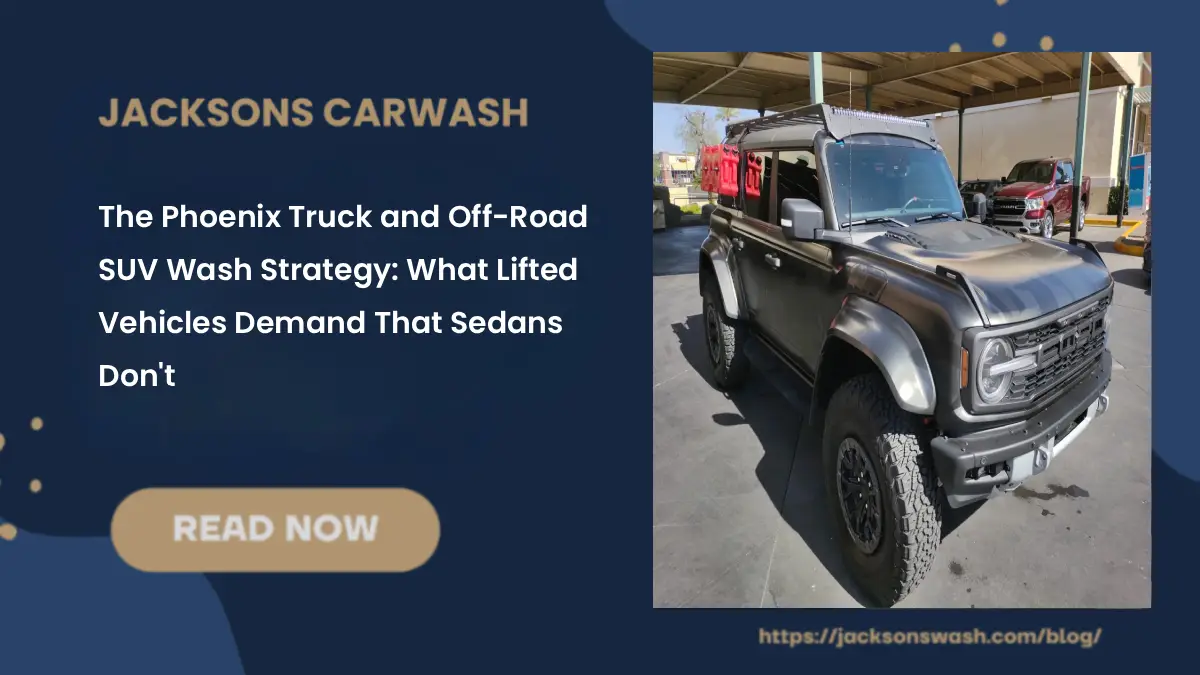
A pickup truck or lifted off-road SUV doesn’t clean up the same way a passenger sedan does. The surface area is bigger, the ground clearance is higher, the body geometry is more complicated, the use case is harder on every panel, and the wheels and tires are a different size class. None of that is what mainstream car-wash advice is built around.
The vehicle class isn’t a niche concern in this market. According to Federal Highway Administration data for 2024, Arizona registers more trucks than passenger automobiles — over 4 million trucks statewide (a category that includes pickups, SUVs, and vans) versus 2.3 million automobiles. A wash designed around a sedan leaves a truck visibly clean across the upper panels while contamination accumulates in the surfaces and crevices that only exist on a truck or off-road SUV. Over time, those surfaces are where finish, function, and resale value erode.
The breakdown below walks through what makes a pickup or lifted SUV a different cleaning problem, which surfaces are unique to the vehicle, what most wash setups miss, and what to actually look for in a routine that fits.
The Vehicle Math: Why Trucks and Lifted SUVs Are a Different Cleaning Problem
Start with surface area. A full-size pickup or full-size body-on-frame SUV is substantially larger than a midsize sedan in every direction — longer wheelbase, taller stance, wider track, higher hood line — and that’s before counting the bed, fender flares, roof racks, wheel-well openings, running boards, and exposed undercarriage. More surface means more landing area for any contamination — dust, road grime, brake dust, airborne particulate — and more square footage that has to be properly cleaned per visit.
Ground clearance compounds the problem. A typical sedan rides at 5–6 inches of static clearance. A stock half-ton truck sits at 9–10 inches. Off-road-trim variants — Raptor, ZR2, TRD Pro, Power Wagon, Bronco Raptor, Wrangler Rubicon — and lifted aftermarket setups push that clearance to 12 inches or more. Each additional inch increases the volume of road spray, suspension-deposited particulate, and tire-rooster contamination the vehicle takes on through normal driving. Suspension components, frame rails, brake hardware, and inner wheel-well surfaces are all exposed in ways a sedan’s flat undertray hides.
Then there’s body geometry. A sedan’s exterior is largely closed and aerodynamic, with smooth panel transitions and tucked underbodies. A truck or off-road SUV has open cargo areas, fender flares with bolt-on hardware, roof rack mounting points, exposed step rails, and panel seams designed for cargo and abuse rather than airflow. Each of those features is a contamination collection point a sedan doesn’t have.
Use case is the last factor, and arguably the biggest. Trucks and lifted SUVs in this region carry mulch, gravel, rebar, jobsite tools, dogs, lake gear, hunting equipment, dirt bikes, overlanding gear — the full range of working and recreational cargo. The cargo area itself becomes a contamination source that propagates into door seams, tailgate hinges, bedliner cap channels, and roof rack mounting points. Recreational off-road and trail use adds an entirely separate class of contamination — sediment, mud, trail debris — that sedans simply never encounter.
Sedans by design don’t see any of this. The wash strategy that suits them won’t suit a truck.
The Specific Surfaces a Truck Has That a Sedan Doesn’t
Run through the surfaces that drive the cleaning problem on a truck or off-road SUV:
Bed walls, bed floor, and bed seam channels. The cargo bed of a pickup is an open contamination volume. Cargo dust, sediment, and debris settle into bed corners, drain holes, tailgate hinge channels, and the seam where the bedliner meets the rail cap. Material that gets into those channels grinds against paint and metal every time the truck flexes or hauls.
Tailgate hinges and latching hardware. Tailgate hinges collect grit that audibly grinds when the gate operates. Multi-function tailgates with split-folding or step-out features add additional pivot points that trap contamination.
Fender flares and wheel-arch hardware. Off-road and full-size trim packages include flared fenders with exposed bolts, gaskets, and inner liner edges. Each bolt head and gasket interface is a collection point. Mud, dust, and trail sediment pack into those crevices and resist standard wash water.
Frame rails, transfer cases, and exposed drivetrain components. Body-on-frame construction means the frame, transfer case, differential housing, control arms, and skid plates are exposed to road and trail contamination from below. Sedan unibody construction tucks all of this behind a mostly flat undertray. The result is that what accumulates under a Phoenix truck is on a different scale than what builds up under a sedan.
Step rails, nerf bars, and running boards. These pick up road spray on every drive and are often the dirtiest single component on a daily-driven truck. Owners frequently load them further when stepping out of the vehicle in muddy or dusty conditions.
Mud flaps, splash guards, and rear bumper steps. Each of these features is positioned to intercept road spray, which means each is constantly contaminated.
Roof racks, overlanding crossbars, and accessory mounts. Lifted off-road SUVs and overlanding-built pickups commonly carry roof racks, light bars, fuel can mounts, recovery gear, and additional hardware. Each crossbar interface, bolt head, and accessory mount is a contamination collection point above eye level — meaning owners rarely see how dirty those surfaces have become until they’re cleaned for the first time in months.
Larger wheel barrels with deeper concave profiles. Truck and lifted-SUV wheels run in larger diameters (typically 18–22 inches) with deeper concave geometry than passenger-car wheels. They collect more brake compound by mass, and the deeper barrel construction traps contamination in regions a flat sedan wheel doesn’t have.
Off-road tire tread patterns. Aggressive all-terrain and mud-terrain tires carry significantly more material in their tread blocks than highway tires. Sediment, mud, and rock fragments wedge into tread voids and persist long after the visible portion of the tire has been rinsed.
None of these surfaces exist on a sedan. All of them require deliberate attention to clean properly.
Why Most Wash Setups Aren’t Built for Trucks or Lifted SUVs
The car-wash industry historically calibrated equipment around sedan dimensions and sedan contamination loads. Tunnel design, equipment geometry, chemistry programs — all built around the sedan as the design target. Much of that infrastructure hasn’t kept up with what’s actually on the roads today.
Tunnel clearance is the most obvious physical limitation. A lot of older express and full-service tunnels were built for passenger-vehicle height and topped out at 7 feet of vertical clearance or below. A stock full-size truck or full-size SUV can already brush the ceiling on those tunnels. A lifted or off-road-trim vehicle won’t fit at all. Owners who’ve had a hard contact with a wash arch, mitter curtain, or overhead manifold typically don’t come back, which leaves a meaningful percentage of the truck and SUV population chronically under-washed.
Undercarriage capacity is the next gap. Most modern tunnels include some form of undercarriage spray, but those systems vary widely in pressure, coverage angle, and dwell time. A low-pressure undercarriage rinse is essentially symbolic on a vehicle carrying months of accumulated sediment in frame channels, control-arm pockets, and fender liner cavities. A real undercarriage flush means a high-volume, high-pressure manifold that hits suspension components, the differential housing, frame rails, transfer-case area, and inner wheel wells with directed flow — not a low-pressure misting pass at the tunnel entrance.
Wheel and tire cleaning is the third soft spot. Truck and lifted-SUV wheels run larger in diameter, deeper in concave profile, and dirtier under brake-dust load than sedan wheels. A wheel-cleaning station calibrated for a 17-inch sedan wheel with a flat face won’t replicate the same outcome on a 20-inch truck wheel with deep concave geometry — unless the wash is using truck-appropriate wheel detergents and full-coverage spray geometry sized for the larger barrel. Tire cleaning matters more, too, because off-road tire tread wedges contamination into voids that simple rinsing doesn’t reach.
Friction material is the last variable, and the one most owners don’t think about. Modern soft-touch foam systems are gentler on paint than older bristle setups and significantly safer than fully touchless tunnels for most contamination loads. The catch: soft-touch friction depends on aggressive pre-rinse and sufficient foam dwell time before contact. A heavily contaminated truck — particularly one returning from off-road or jobsite duty — can carry abrasive sediment into the friction stage if the pre-rinse isn’t built to handle that load. That isn’t a problem on a clean sedan. It is a real problem on a dust-loaded pickup or lifted SUV.
What a Truck and Off-Road-SUV Friendly Wash Setup Actually Looks Like
A wash setup engineered for the realities of pickup and lifted-SUV ownership shares five characteristics:
Tunnel clearance high enough to accept full-size and mildly lifted vehicles. Modern tunnels generally accommodate stock and modest-lift configurations, but clearance varies by location and equipment. Owners with significantly lifted setups, larger aftermarket tires, or roof-mounted accessories should confirm vehicle height with the wash before pulling in. A tunnel that doesn’t publish its clearance — or visibly looks tight at the entrance — is worth checking on first.
An aggressive pre-soak phase using alkaline chemistry. Pre-soak detergents formulated with high-pH alkalinity break the bond between organic debris, road grime, and clear coat before the friction stage of the wash. On a truck carrying heavy contamination, the pre-soak does more of the actual cleaning work than the foam itself. A pre-soak that looks like a quick mist is not built for truck loads.
A high-pressure undercarriage flush with sustained coverage. That means high-volume manifolds, multiple spray angles, and enough dwell time to displace loaded sediment in frame channels, suspension cavities, and inner fender wells.
Wheel cleaning that physically contacts the wheel barrel. Some tunnels rely entirely on chemical and rinse without dedicated wheel-cleaning brushes or directed jets at the wheel face. That approach is inadequate for truck-class wheels under typical brake-dust load. Look for tunnels with rotating wheel brushes or directed wheel-jet manifolds sized for larger wheel diameters.
Spot-free or RO-treated final rinse. A truck’s larger surface area dries with visibly more spotting than a sedan if the final rinse is untreated tap water. Spot-free rinse is a baseline requirement, not an optional upgrade.
A wash that hits all five handles a truck or lifted SUV the way it actually needs to be handled. A wash that misses two or more is performing a sedan-level service on a vehicle carrying sedan-plus contamination.
Frequency: Trucks and Off-Road SUVs Need More Washing, Not Less
A common assumption among truck and lifted-SUV owners is that rugged, work-oriented vehicles can tolerate longer intervals between washes than passenger cars. Real-world observation in service yards and detail shops consistently suggests the opposite.
The same factors that make trucks and lifted SUVs accumulate contamination faster also make that contamination bond more aggressively the longer it sits. Brake compound pits clear coat. Sediment grinds at paint where bedliner caps meet rail tops. Trail debris embeds into fender flare edges. Cargo residue works into seam channels and cures there. The longer the gap between washes, the higher the probability of permanent damage that can no longer be reversed by washing alone.
For a daily-driver pickup or lifted SUV, a one-to-two week wash cadence keeps contamination from setting. For work trucks moving between jobsites, a weekly cadence is closer to the floor, not the ceiling. For lifted off-road vehicles that take regular dirt-road duty, a wash within 24–48 hours of trail return is the difference between rinsing off mud while it is still soft and chiseling out hardened sediment later.
This is the part of truck and SUV ownership that owners most consistently underbudget. A wash routine matched to actual contamination exposure is not optional preventive maintenance — it is the cheapest finish-preservation step available, and it compounds over the vehicle’s life. The cost of an unlimited wash plan over five years is substantially less than the cost of a single full paint correction on a truck-sized vehicle.
Where Jacksons Fits Into This
Jacksons Car Wash operates multiple locations across the Phoenix metro, with tunnels configured to accept full-size pickups and many factory off-road and mild-aftermarket configurations. Pre-soak chemistry, high-pressure undercarriage flush, dedicated wheel cleaning, and spot-free RO-treated final rinse are built into the standard wash flow rather than priced as paid add-ons. Owners with significantly lifted setups or oversized tires should check with their local store on vehicle clearance before pulling in.
For owners running pickups and lifted SUVs through real working and recreational use — jobsite duty, weekend trails, lake hauls, ranch roads, daily commutes — a wash setup engineered around the vehicle is what separates a truck that ages well from one that visibly shows every mile.
Find a Jacksons Location Near You
Jacksons Car Wash has multiple locations across the Phoenix metro, each set up to handle full-size pickups, factory off-road trims, and most mild-aftermarket configurations. Find the closest store, check hours, and confirm vehicle clearance on the Jacksons locations page before your next wash.
The Bottom Line for Phoenix Truck and Lifted-SUV Owners
A pickup or lifted off-road SUV is a different cleaning problem than a sedan in this metro, and it deserves a different approach. Bigger surfaces, higher clearance, more complex geometry, harder use — all of it adds up to a vehicle that needs a wash setup built for what it’s actually carrying. “Truck-friendly wash” isn’t marketing. It’s a structural distinction defined by tunnel clearance, pre-soak chemistry, undercarriage capability, wheel-cleaning depth, and rinse-water quality.
Owners who match their wash routine to those realities end up with vehicles that hold their finish, function, and resale value over the long run.
Most factory off-road trims and mild aftermarket lift configurations fit through Jacksons tunnels without issue. Significantly lifted setups, oversized tires, or roof-mounted accessories may approach the clearance limit depending on the location. Owners with modified vehicles should call ahead or check with on-site staff before pulling in to confirm clearance for their specific build.
Truck and lifted-SUV owners who drive off-pavement or work jobsite duty should wash within 24 to 48 hours of returning. Trail mud, jobsite residue, and unpaved-road sediment bond more aggressively as they dry, and the longer that material sits in fender wells, frame channels, and bedliner cap seams, the harder it is to remove without abrasive intervention. Weekly washing is the practical floor for active work and recreational use.
Most factory and properly installed aftermarket roof racks, low-profile crossbars, and standard light bars clear modern tunnels without issue. Tall overlanding setups with rooftop tents, awnings, mounted recovery boards, or oversized fuel cans may exceed tunnel clearance. The safest approach is to measure total vehicle height with all accessories installed and confirm against the wash’s posted clearance before pulling in.
Truck and lifted-SUV wheels run in larger diameters (typically 18 to 22 inches) with deeper concave geometry than passenger-car wheels. They also collect more brake compound by mass because of heavier braking systems and higher vehicle weight. The deeper barrel construction traps contamination in spoke pockets and inner barrel surfaces that flat sedan wheels don’t have, which is why a wash calibrated for sedan wheels often leaves truck wheels visibly dirty even after a full cycle.
If possible, knock loose mud and large debris from fender wells, running boards, and the undercarriage with a low-pressure rinse before driving home. Once trail sediment dries on hot panels, it becomes substantially harder to remove cleanly. Plan the wash itself within 24 to 48 hours of trail return, and choose a tunnel with high-volume undercarriage flush and aggressive pre-soak rather than a quick-pass express setup, since the contamination load is well beyond what a sedan-calibrated wash is built to handle.