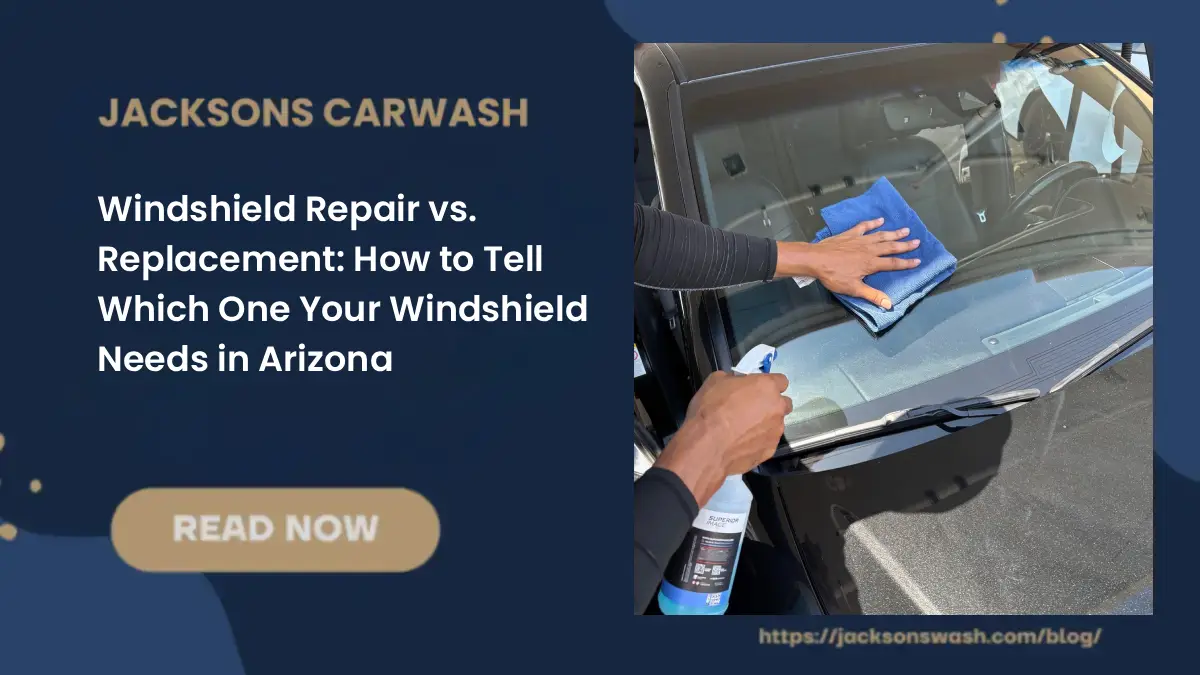
Our auto glass technicians see the same pattern across the Valley every week. A driver picked up a pea-size chip, it wasn’t in the way, and they meant to deal with it. Then one July afternoon they got into a car that had been baking in a parking lot, turned the air on, and by the time they got home there was a crack halfway across the glass.
That chip was a twenty-minute repair. The crack is a replacement. The difference came down to a few days. This guide explains how to read windshield damage, where the line between repair and replacement sits, and why that line moves faster in Arizona than almost anywhere else.
The short answer
A chip can be repaired if it is smaller than a quarter, sits outside the driver’s direct line of sight, is at least two inches from the edge of the glass, and hasn’t gone through to the inner layer. A single crack can often be repaired if it is shorter than about six inches and meets those same conditions.
Anything larger, anything directly in front of the driver, anything touching the edge, and anything that has penetrated both layers means replacement. The rest of this article is the reasoning behind those rules.
Why chips become cracks so fast in Arizona
A windshield is two sheets of glass bonded around a layer of clear plastic. A rock fractures the outer sheet, the plastic holds everything in place, and the chip is stable as long as nothing makes the glass move.
What makes glass move is temperature. On a Phoenix summer afternoon, the outer surface of a windshield parked in the sun can run well above 150 degrees, and the glass is stretched. Then the driver starts the car and points the vents at it. The inside surface cools within seconds while the outside stays hot. The two surfaces are now trying to be two different sizes, and that stress goes to the weakest point in the glass, which is the chip. That’s the crack that seems to appear from nowhere on the drive home.
The same thing happens in reverse on a January morning when the defroster hits cold glass. Arizona puts a windshield through this cycle nearly every day for half the year. A chip that might sit quietly for a year in a milder climate often runs within a week or two here. In this state, a repairable chip has a short shelf life.
Reading the damage: which types repair and which replace
Technicians sort damage into a handful of shapes, and the shape largely decides the answer.
Bullseye. A round, cone-shaped chip with a dark center from a rock hitting straight on. The most repairable type. Resin fills the cone cleanly and the result is often close to invisible. Repair.
Half-moon. A bullseye that didn’t form a full circle. Same behavior. Repair.
Star break. An impact point with short cracks radiating out like legs. Repairable when the legs are under an inch or so. The longer they get, the more likely one keeps running after the resin cures. Repair if small, replace if the legs have spread.
Combination break. A bullseye with star legs. Repairs well when caught early but is the most sensitive to heat, because the legs give stress more places to work. Repair, and do it quickly.
Edge crack. Any crack starting within roughly two inches of the perimeter. The edge carries the most structural load, and resin doesn’t bond reliably that close to the frame. Replace.
Long crack. A single crack longer than about six inches. Some shops attempt repairs up to that length. Past it, the honest answer is replacement. Replace.
The five-question check
Run your windshield through these. A yes on all five points to repair. A no on any one points to replacement.
- Is the chip smaller than a quarter? Repair resins are designed for damage about an inch across or less.
- Is any crack shorter than a dollar bill? A bill is about six inches. Hold it against the crack.
- Is the damage outside the driver’s direct view? Even a good repair leaves a faint mark, and most technicians won’t put one in the driver’s sightline.
- Is it at least two inches from the edge? Closer than that and the bond between glass and frame is in question.
- Is the inner layer intact? Run a fingernail over the inside of the glass at the damage point. If it catches, the break went through both layers, and resin can’t fix that.
A sixth question that isn’t on any official list: how long has it been sitting? An old chip fills with dust, washer fluid, and moisture. The resin still bonds, but less cleanly. A chip fixed the same week is a better repair than one fixed the same season.
What a repair actually does
A repair doesn’t erase a chip. It stops the chip from becoming a crack. The technician cleans the impact point, draws a vacuum to pull out air and moisture, injects a clear resin matched to the glass, and cures it under UV light. The resin bonds the fractured glass back together so temperature stress has nothing left to work on.
A proper repair restores most of the strength at that point and takes twenty to thirty minutes in a parking lot. It is prevention, not cosmetics, and the earlier it happens, the better it works.
When replacement is the only honest answer
Repair is usually the right first instinct. But there are cases where a shop offering to repair instead of replace is doing the customer a disservice. A crack at the edge will keep growing; a repair buys a week. Damage in front of the driver leaves a blemish in the one spot that has to be clear. Three or four chips on one windshield add up to glass weakened in several places. Damage through both layers can’t be filled. And a chip that has already been repaired once doesn’t take a second repair well.
This matters because a windshield is structural. In a rollover it helps hold the roof up. In a frontal collision it’s the surface the passenger airbag deploys against. A cracked windshield does both jobs worse than an intact one.
Cost shouldn’t be the reason to delay either one. Arizona requires every insurer writing comprehensive coverage to offer zero-deductible windshield glass coverage under A.R.S. § 20-264. It has to be on the policy, but for most Arizona drivers the out-of-pocket cost for either repair or replacement is zero.
Get it looked at before the weather decides for you
Jacksons performs on-site chip repairs at its Valley locations, and full replacement is available with free mobile service anywhere in Arizona. If you’re not sure which one you need, a technician can tell you in about a minute.
No. A fresh bullseye can come out close to invisible, but most repairs leave a faint mark at the impact point. The goal is to stop the damage from spreading and restore strength, not to make the chip disappear.
Kits can work on a small, fresh bullseye if the instructions are followed exactly. They fail more often on star and combination breaks because they can’t draw enough vacuum to clear air from the legs before the resin goes in. A failed DIY repair can’t be redone professionally, so anything other than a simple round chip is safer done once, correctly.
Days, not weeks. From May through October, the swing between sun-heated glass and an air-conditioned cabin stresses the chip every time the car is driven, and summer chips frequently run within a week. Park in shade, keep cold air off the glass, and get it repaired as soon as possible.
Almost always temperature. A car that cooled overnight and then sat in morning sun, or a defroster aimed at cold glass, puts the two surfaces of the windshield at different temperatures. The chip is the weakest point, so that’s where the glass gives. It rarely has anything to do with how the car was driven.