Key Takeaways
- Modern tunnel car washes are engineered for the majority of vehicles on Phoenix roads — sedans, crossovers, full-size pickups, and most factory and mild-aftermarket trims.
- A defined minority of vehicles should not enter an automatic tunnel: classic and vintage cars with single-stage paint, soft-top convertibles, vinyl-wrapped vehicles, cars with compromised paint or tint, open Jeeps and Broncos, and significantly lifted or tall-accessory builds.
- The damage from using the wrong wash service on these vehicles is often cumulative and permanent — accelerated seam wear on soft tops, lifted wrap edges, micro-scratched vintage paint, soaked interiors.
- Jacksons’ Signature Hand Wash at the Scottsdale and San Tan Marketplace locations is built specifically for vehicles outside tunnel parameters.
Why Some Vehicles Aren’t Compatible with Tunnel Equipment
Tunnel car wash equipment is calibrated around assumptions: a clear-coated factory paint finish, a closed body envelope, secure trim and emblems, a roof line within the tunnel’s clearance, and either no aftermarket accessories or accessories rated for water and contact exposure. When those assumptions are violated, the equipment still performs the same operations — pre-soak chemistry, soft-touch friction, high-pressure rinse, forced-air drying — and those operations cause measurable damage on a vehicle that wasn’t built to receive them.
The honest map comes down to whether the vehicle matches the equipment’s assumptions or violates them.
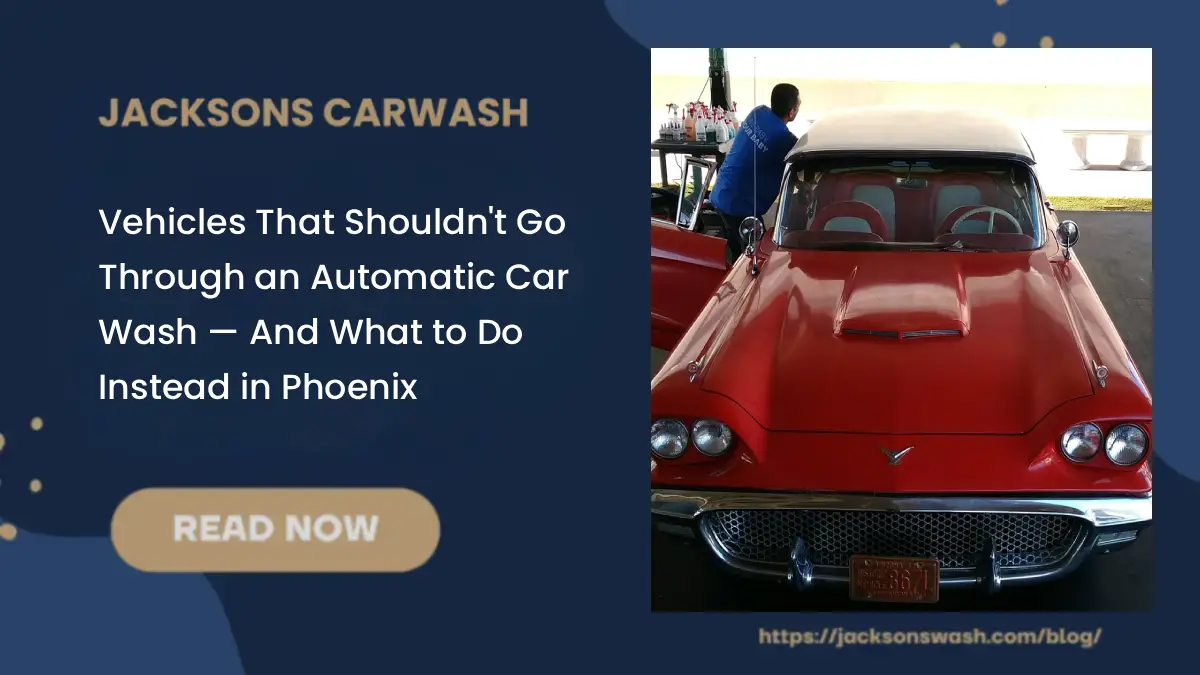
Classic and Vintage Cars with Single-Stage or Lacquer Paint
Vehicles built before the widespread adoption of clear-coat paint systems — generally pre-1985 for most domestic manufacturers — use single-stage enamel or lacquer-based paint. Color and shine come from the same coat, which is thinner, softer, and far more vulnerable to micro-scratching, oxidation, and chemical sensitivity than a modern clear-coat surface. A soft-touch friction system that glides harmlessly across a 2020 sedan’s clear coat can micro-scratch a 1968 Mustang’s original lacquer.
Hagerty, the recognized authority on classic and collector vehicles, advises classic car owners to skip automated car washes entirely, noting that even soft-touch tunnel systems can scratch vintage paint or damage emblems and trim. Chrome trim, mazak diecast emblems, and original hood ornaments common on pre-1980s vehicles add a second layer of risk.
Owners of classic, antique, and survivor-grade vehicles belong in a hand wash bay. Jacksons offers Signature Hand Wash service at the Scottsdale and San Tan Marketplace locations specifically for this kind of vehicle.
Convertibles with Soft Tops
Cloth, canvas, and vinyl convertible tops share a vulnerability: they are stitched, sealed, and tensioned at seam lines that water can penetrate under direct pressure. A tunnel’s high-pressure rinse is engineered to displace contamination from hard panels, not to wash a fabric assembly. Repeated tunnel washes accelerate seam wear, encourage water intrusion at stitched edges, and degrade the top’s protective coating prematurely.
This applies to Mazda Miatas, BMW Z4s, Porsche Boxsters, Jeep Wranglers, Bronco soft-top configurations, and similar vehicles. The damage is cumulative, not single-event — a single tunnel visit rarely causes visible immediate harm, but the long-term cost is meaningful.
Vehicles with Vinyl Wraps
Vehicle wraps are vulnerable at their edges and seams. High-pressure tunnel rinses can creep under wrap edges, especially on wraps over a year old, wraps installed without adequate post-cure time, or wraps with any existing lifting at corners or seams around handles, mirrors, and panel gaps. Once water gets under the wrap, the failure cascades — lifted edges expand, adhesive compromises, and what was a clean wrap becomes a damaged one requiring expensive removal and replacement.
Wrap film manufacturers consistently recommend hand washing as the safest care routine. The conservative call for any wrapped vehicle is a hand wash bay.
Vehicles with Compromised Paint, Tint, or Body Trim
Tunnel equipment doesn’t distinguish between healthy paint and compromised paint. A clear coat that’s already failing will lose more material under tunnel friction. Window tint that’s bubbling or lifting will accelerate that failure under high-pressure water. Body trim with loose clips or compromised adhesive can dislodge entirely.
This category also includes vehicles with recent paint repairs that haven’t fully cured (typically 30 to 60 days post-paint), aftermarket body kits secured with adhesive rather than mechanical fasteners, non-OEM emblems and stick-on accents, and matte or satin paint finishes — which require their own specific care strategy.
Open Jeeps, Broncos, and Doors-Off Configurations
Modern Jeep Wranglers, Ford Broncos, and similar body-on-frame off-road vehicles are designed for door, top, and panel removal. Owners running their vehicles with the doors off, top down, or roof panels removed cannot use an automatic tunnel without taking water directly into the cabin.
Tunnel water at full pressure will fill floor pans, saturate seat upholstery, drench electrical components in the dash, and pool in drainage channels. Even with floor drain plugs open, the volume of water introduced is well beyond what those drains are sized to handle. Drivers running open configurations should reinstall doors and tops before any tunnel visit, or choose a hand wash where water volume and direction are controlled.
Vehicles with Tall Roof-Mounted Accessories or Significant Lift
The clearance ceiling on any tunnel is fixed. Vehicles with rooftop tents, awnings, mounted recovery boards, oversized fuel can racks, tall light bar arrays, or significant aftermarket lift can exceed that ceiling — sometimes by margins small enough that owners aren’t aware of the conflict until contact occurs.
Significantly lifted vehicles, oversized tires, and tall roof accessories that exceed tunnel clearance belong in a hand wash bay. Phoenix pickup and lifted SUV owners have their own broader wash considerations to weigh.
Find the Right Jacksons Service for the Vehicle
Vehicles outside the exclusion categories — most sedans, crossovers, factory pickups, factory off-road trims, and mild aftermarket configurations — are fully served by Jacksons’ standard tunnel washes across the Phoenix metro. Vehicles within the exclusion categories belong in a hand wash bay, where water pressure is controlled, contact is selective, and detergents and finishing products can be matched to the specific surface. Jacksons’ Signature Hand Wash service at the Scottsdale and San Tan Marketplace locations is built for exactly this — classic vehicles, convertibles, wrapped cars, and modified builds that need a wash matched to what the vehicle actually is. Find the closest Jacksons location and route accordingly.
Classic vehicles with single-stage or lacquer paint, original chrome trim, and pre-1985 body construction should not enter an automatic tunnel — even modern soft-touch systems. Vintage paint chemistry doesn’t tolerate machine-applied friction the way modern clear coat does, and original trim and emblems can be lifted or damaged by tunnel equipment. Hand washing is the standard recommendation for these vehicles.
A freshly installed, factory-quality wrap with no edge lifting can generally tolerate soft-touch tunnel washes, but the risk profile worsens with age, prior wash cycles, and any existing edge or seam compromise. Most wrap film manufacturers recommend hand washing as the safest long-term care strategy. Older wraps or wraps with any visible edge lifting should always be hand-washed.
A single tunnel visit on an otherwise healthy soft top rarely causes immediate visible damage. The risk is cumulative — repeated high-pressure tunnel washes accelerate seam wear, encourage water intrusion at stitched edges, and degrade factory water-resistant coatings, shortening the top’s service life. Owners of Mazda Miatas, BMW Z4s, Porsche Boxsters, Jeep Wranglers, and Bronco soft-top configurations should default to a hand wash for routine care, especially as the top ages and factory waterproofing wears.
No. Vehicles with doors removed, soft tops down, or roof panels taken off cannot use an automatic tunnel without taking water directly into the cabin. Tunnel water at full pressure will saturate seat upholstery, drench dash and console electrical components, and pool in floor channels faster than the vehicle’s drains can clear it. Drivers running their Wranglers, Broncos, or similar vehicles in open configurations should reinstall doors and tops before any tunnel visit, or choose a hand wash where water volume and direction are controlled.